Hardware Lead, Mechanism Design
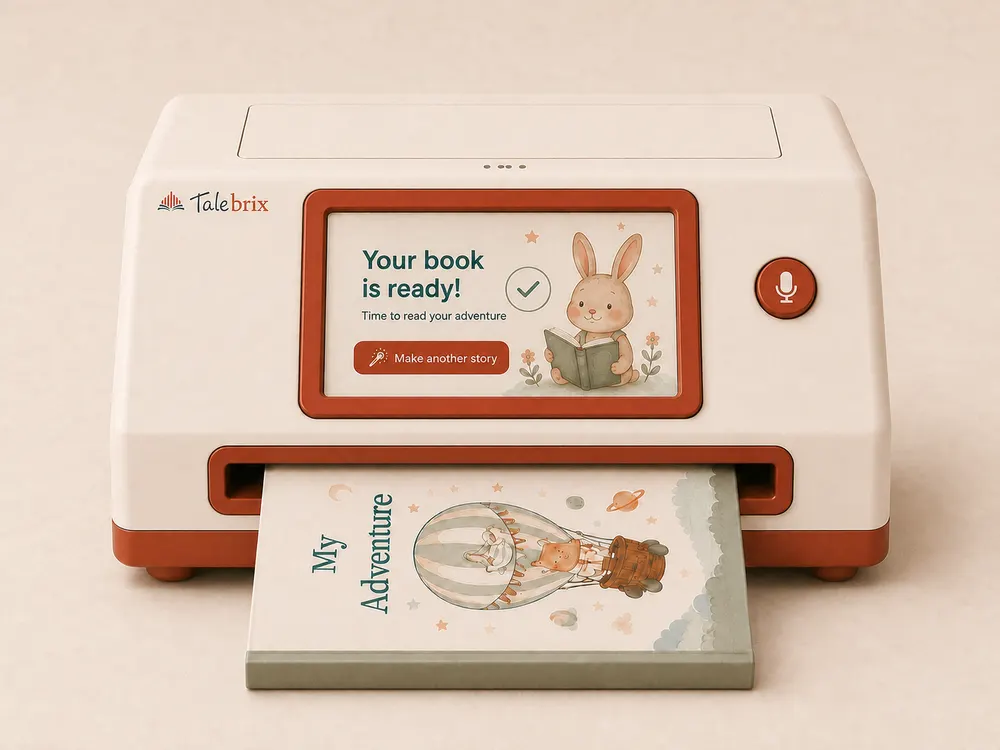
A child tells Talebrix a story. The goal is a real picture book, printed and bound, within minutes. The part that binds it is designed and with our manufacturer. Making it work, in thousands of machines, for years, is the hardest job in the company, and it would be yours.
Why it is hard
Making a book is not difficult. Bookbinding is a solved industry. It is solved with heavy machines, in factories, by trained people, at scale.
We have to do it in a box about the size of a shoebox, sitting on a shelf in a child's bedroom, next to a four year old. It has to work first time, every time, without an adult understanding anything about how it works. It has to be quiet enough for bedtime. It has to survive being shipped, knocked and ignored for six weeks at a time. And the whole machine has to sell for £199 with 4 books included, which means the binding mechanism costs less than a takeaway.
Every industrial answer to this problem is too big, too loud, too hot, too expensive, or needs a technician. So the answer has to be a new one.
- In a bedroom
A box 360 × 250 × 225 mm, beside a four year old. Not a workshop, and nobody in the room understands the mechanism.
- Quiet
It runs at bedtime, in the room somebody is about to be read to in: under 55 dBA at a metre.
- Left alone
Shipped, knocked, and then ignored for six weeks at a time. It has to work first time when somebody comes back to it.
- Cheap
The whole machine sells for £199 with 4 books included. The binding mechanism costs less than a takeaway.
Where we have got to
We have a design. The mechanism is modelled in CAD, the model has gone to our manufacturing partner, and patent applications covering the method are being filed. It is a genuinely different approach to holding a book together, and we think it is the reason this product can exist at a price families will pay.
What we do not have is the engineer who owns it: someone who can read that design critically, answer the manufacturer's questions about it, change it where it is wrong, and be accountable for it binding a real book, first time, in every machine. That is the gap.
We will show you the whole design under NDA, early, before you decide anything. Then you tell us whether it will work, what needs changing, or whether you have a better idea. We would take a better idea over a defended one.
Three phases, and why this is a career rather than a project
The three below run in order and the last one does not end. That is the argument for taking this as a career rather than a contract to solve one problem: the machine and the material it works on are a single invention, and the person who takes over the first phase is the only person who can hold the third.
- Take it over
Over the coming weeks the design becomes yours. Learn it, test it against the manufacturer's first parts, fix what is wrong with it, and get it to fold and bind a real book in front of investors in November. That demonstration is the single thing the next twelve months depend on.
- Ship it
Through 2027, from that rig to a product. The manufacturing partner is chosen. Shrink the mechanism into the real machine, make it repeatable across thousands of units, make it survive a courier and a child, and hold it to the £199.
- Own it
Then it keeps going, because we make our own materials in house: the production line that makes the books is yours as well as the machine that binds them. Alongside that, reliability, cost, and version two, which is smaller and is the interesting one.
What is not yours
Industrial design, electronics, firmware, the software that writes and illustrates the books, and the commercial side of the factory relationship. Those are covered. You do the mechanism.
Who you are
You have made paper move through a machine before, and you know that paper is a liar. Printers, receipt printers, ticket machines, label applicators, packaging and folding lines, photo booths, cash machines, vending. That history matters more to us than general hardware experience, and being someone who builds a rough version this week matters more than both.
If you have taken a physical product from something that worked on a bench to something in boxes on a pallet, and you can name the month it slipped, we want to hear from you.
What you would be paid, and when
£90,000 annual gross salary and 10% equity, subject to funding, vesting and agreed terms. Vesting, IP assignment and appointment terms will be agreed individually before work starts. Paid work depends on funding; no start date is promised.
Materials, parts, tools and rig time are paid for by us.
None of this has shipped yet. The prices are intent and so are the specifications. The mechanism is designed and with the manufacturer, and it is not proven until it binds a book in every machine that leaves the line. That is the offer: whoever makes it work owns a piece of it.
How to apply
Email hello@talebrix.com, name this role, and answer one question. Tell us the closest thing you have ever built to this, and what went wrong with it.
Be first to hear when Talebrix is ready
Leave an email and we will write to you twice: once now, to say you are on the list, and once when they are ready.
Join the launch list