Everything About Volcanoes
It starts with a little idea…
Mila (child)“I want a book about volcanoes. Real stuff. What’s inside them? Is lava fire? And do they all go bang, or can it just come out?”
Parent“Would you like a story, or a book with facts?”
Mila (child)“Facts. But put a bear in it. He can find things out with me.”
A hard black rock has Bear asking questions. Follow him through the museum to find out what happens inside a volcano, and what comes out.
Back cover, spine and front cover
Turn with the buttons, swipe across the book, or use your keyboard arrows.
What will your child’s book be about?
Talebrix is designed to turn their spoken ideas into a real personalised book, with their name as the author.
Get first accessJoin the list for first access when pre-orders open. No payment required.
Read the whole story as text
The rock that used to flow
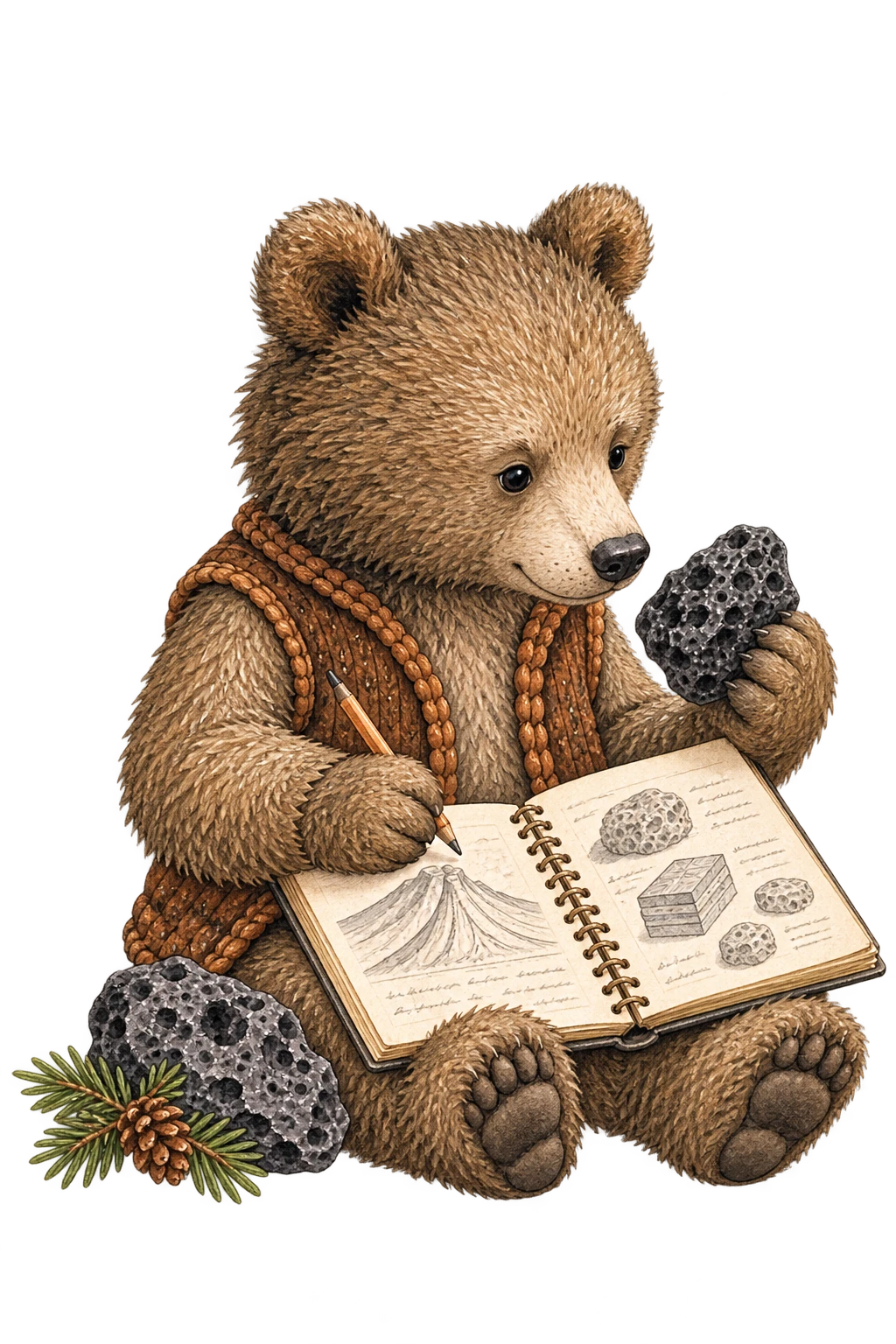
Bear put a black rock on the table. It was cold. It was hard. “This used to be lava,” said the museum guide. Bear turned it over in his paws. “How can a rock flow?” He opened his notebook. That was his first question.
Under the ground
Some rock beneath the Earth’s surface is so hot that it melts. This molten rock is called magma. Magma can collect underground and rise through cracks. A volcano is a place where magma reaches the surface. Once it comes out, we call it lava. Same molten rock. A different name.
Does it always go BANG?
Bear drew a volcano with a huge cloud above it. “Does every eruption look like that?” he asked. No. Some eruptions send lava flowing across the ground. Others blast out ash and pieces of rock. Gases in magma can help drive an eruption. A volcano is not a bonfire. Its glowing lava is very hot rock.
A cloud made of rock
Volcanic ash is not the ash left by a wood fire. It is made of tiny pieces of rock, minerals and volcanic glass. Those little pieces can travel in the air and fall far from a volcano. Bear looked at a sealed jar of grey ash. “A rock cloud,” he whispered. He added it to his notebook.
Two different shapes
Volcanoes do not all look alike. A shield volcano is broad, with gentle slopes. Runny lava can spread a long way before it cools. A composite volcano is often taller and steeper. Layers of lava and other erupted material build it up over many eruptions. Bear drew both shapes. Not every volcano was a pointy mountain.
Listening to a mountain
Scientists look for clues that a volcano is changing. They measure earthquakes, escaping gases and tiny movements of the ground. These clues help them judge what may happen next. They cannot give every eruption an exact time. Bear watched a line wriggle across a museum display. “You can listen without putting your ear on it.”
Back to the black rock
Bear picked up his rock again. Lava cools and hardens into rock. Now he knew how this hard little thing could once have flowed. He drew arrows in his notebook: magma beneath the ground, lava at the surface, then cooled rock. His first question had an answer. Under it, Bear wrote another: “What else can a volcano make?”
An illustrated example of the experience we are developing. Talebrix is still in development; this book was not printed by the device.